

Our Experts Are Here to Help
1.877.299.4564
Thursday, August 12, 2010
New York State: Aggressive Driving and Road Rage
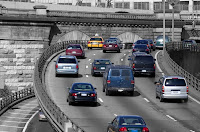
What is Aggressive Driving?
Before defining what aggressive driving is, let’s define what it is not. Although commonly used interchangeably, aggressive driving and road rage are not synonymous with each other. Road rage refers to a criminal offense or violent crime. For example, using a vehicle as a weapon and assaulting a driver are both examples of road rage.
New York State Police define an aggressive driver as a person who “Operates a motor vehicle in a selfish, bold or push manner, without regard for the rights or safety of other users of the streets and highways.” Using this definition makes it easier for people to distinguish between the two.
>Spotting an Aggressive Driver
If it seems that aggressive drivers are all over New York State, it is probably because they are. Instances of aggressive driving are increasing. The increase is typically associated with the overcrowding of roadways which leads to congestion which causes drivers’ frustration. To ensure safety on the roadways it is important to understand how to spot an aggressive driver. The following traffic violations are typically displayed by aggressive drivers:
- Speeding
- Frequent and/or Unsafe Lane Changing
- Failing to signal a lane change or turn
- Tailgating
- Failing to Yield to the driver with the Right of Way
- Running traffic lights
- Driving while impaired
- Remain Calm
- Maintain a Safe Distance
- Do not pass, unless it’s absolutely necessary
- Once it’s safe, change lanes and move out an aggressive drivers way
- If unable to change lines and being tailgated, maintain a safe speed and do not respond to any hostile gestures
- Observe common courtesy.
- Avoid actions that can provoke aggressive behaviors from other drivers.
- Reduce your stress level while driving.
- Keep your emotions in check.
- Before reacting, think about the possible reactions to your reactions.
>>Encountering an Aggressive Driver
After defining the difference between aggressive driving and road rage, the thought of sharing a roadway with an aggressive driver should be less frightening. However, it is still unsafe. Even thought aggressive drivers are not trying to physically harm you, they do not have any regard for the safety of other drivers. If (when) you encounter an aggressive driver, the New York State Police recommends the following basic tips:
>>>Avoiding Aggressive Drivers
Wouldn't it be great if there was a fool proof way to guarantee avoidance of aggressive drivers? Unfortunately, that is not possible. However, there are things drivers can do individually to reduce the likelihood of encountering an aggressive driver. The following tips and the will help drivers ensure their safety.
Adhering to the recommended driving tips listed above will help to avoid the frustration of dealing with an aggressive driver. However, it is important to remember that drivers who are unable to keep their emotions under control while driving are a greater risk to themselves than the people around them are.
Learn more about the Dangers of Aggressive Driving with a safety course from SafeDriver.com.
Additional Articles: Are you and Aggressive Driver?
Labels: aggressive driver, road rage
Posted by NSC - Traffic Safety
at
8:23 AM
0 Comments


Saturday, May 15, 2010
Aggressive Driving: Physics of a Car Crash
In your dreams, you may be the greatest, most-skilled, driver on the face of the earth --- with instantaneous, robot-like reflexes to match and able to decide lightning fast whether a car should stop, slide or turn in any direction. In reality, the laws of physics dictate what will happen to aggressive drivers and their cars in a car crash.
Unfortunately, your competence as a driver in your dreams, does not transfer over into reality. You are only human, with a limited set of speeds (given enough training) and your car is a car: a heavy piece of machinery that is bound by the laws of science.
Do The Math
Imagine that an aggressive driver is traveling at 40mph (in a 30mph zone!) --- he runs a red light (which, assuming he survives, he will claim was yellow) while another driver, crossing with the right-of-way, accelerates to the speed limit.
Human Reaction Time
Assuming each is an average driver, --- not the one with the robot-like reflexes mentioned above --- your reaction time is about ¾ of a second. That means that, when each car comes into the view of the other, it will take about ¾ of a second before each driver is even aware there is an emergency. In that time, the aggressive driver will travel an additional 44.1 feet and the other driver will travel an additional 33 feet before fully realizing there is a problem. Then each driver will have to assess the driving scene and make a decision on how to best avoid the collision either by braking or steering out of the way. Then they will have to put that plan into action. Assuming that the aggressive driver decides to slam on the brakes, it will take up to 1.5 additional seconds to decide what to do and fully apply the brakes. That means he will travel another 73.5 feet before his car even begins to slow.
There isn’t enough time! They are going to crash into each other!
What laws of physics will apply as they crash into one another?
Newton's Law of Motion
The first law of motion is: an object in motion stays in motion. To put it simply: a 3,000 pound car traveling at a 40mph CANNOT just stop abruptly. It will take 120 feet before the speeding behemoth comes to a complete stop. Imagine if both drivers try to stop --- and all they get is 10 mph lower than their current speeds --- lowering their approach rate to 50 mph just before the cars crash into each other.
Using an online crash calculator (http://hyperphysics.phy-astr.gsu.edu/Hbase/carcr.html#cc2 --- yes, I cheated a bit!) and assuming that both cars each weigh 3000 pounds, the force of the collision would look like this:
I probably wouldn't call that crash a fender-bender. What's far scarier --- assume that one of the passengers is a 100-pound girl who decided that day to be “cool” and not wear a seatbelt. The force of her body flying into the dashboard is going to look like this:
A force that great is going to be fatal to her.
However you vary the speed, driving skills and car weights --- there's no denying that the laws of physics will be the one to follow in a car crash. Aggressive drivers aren't superhuman --- they are bound to the same laws of physics rules as the rest of us --- they are just a bit more impatient. The faster an aggressive driver goes, the faster he gets into inescapable jams --- the faster he also gets to the hospital.
Learn more about how to prevent aggressive driving through a 1-hour Dangers of Aggressive Driving course offered 100% online.
Unfortunately, your competence as a driver in your dreams, does not transfer over into reality. You are only human, with a limited set of speeds (given enough training) and your car is a car: a heavy piece of machinery that is bound by the laws of science.
Do The Math
Imagine that an aggressive driver is traveling at 40mph (in a 30mph zone!) --- he runs a red light (which, assuming he survives, he will claim was yellow) while another driver, crossing with the right-of-way, accelerates to the speed limit.
The aggressive driver, running at 40mph is covering 58.8 feet per second. The right-of-way driver going 30mph (the speed limit) is covering 44 feet per second. Combined, they are approaching each other at a rate of 70mph, or 102.9 feet/second.
Human Reaction Time
Assuming each is an average driver, --- not the one with the robot-like reflexes mentioned above --- your reaction time is about ¾ of a second. That means that, when each car comes into the view of the other, it will take about ¾ of a second before each driver is even aware there is an emergency. In that time, the aggressive driver will travel an additional 44.1 feet and the other driver will travel an additional 33 feet before fully realizing there is a problem. Then each driver will have to assess the driving scene and make a decision on how to best avoid the collision either by braking or steering out of the way. Then they will have to put that plan into action. Assuming that the aggressive driver decides to slam on the brakes, it will take up to 1.5 additional seconds to decide what to do and fully apply the brakes. That means he will travel another 73.5 feet before his car even begins to slow.
There isn’t enough time! They are going to crash into each other!
What laws of physics will apply as they crash into one another?
Newton's Law of Motion
The first law of motion is: an object in motion stays in motion. To put it simply: a 3,000 pound car traveling at a 40mph CANNOT just stop abruptly. It will take 120 feet before the speeding behemoth comes to a complete stop. Imagine if both drivers try to stop --- and all they get is 10 mph lower than their current speeds --- lowering their approach rate to 50 mph just before the cars crash into each other.
Using an online crash calculator (http://hyperphysics.phy-astr.gsu.edu/Hbase/carcr.html#cc2 --- yes, I cheated a bit!) and assuming that both cars each weigh 3000 pounds, the force of the collision would look like this:
- Weight – 6000 lbs
- Speed – 50 mph
- Crash Force – 501,779 lbs / 250 tons
I probably wouldn't call that crash a fender-bender. What's far scarier --- assume that one of the passengers is a 100-pound girl who decided that day to be “cool” and not wear a seatbelt. The force of her body flying into the dashboard is going to look like this:
- Weight – 100 lbs.
- Speed – 30 mph
- Crash Force – 3,010 lbs / 1.5 tons
A force that great is going to be fatal to her.
However you vary the speed, driving skills and car weights --- there's no denying that the laws of physics will be the one to follow in a car crash. Aggressive drivers aren't superhuman --- they are bound to the same laws of physics rules as the rest of us --- they are just a bit more impatient. The faster an aggressive driver goes, the faster he gets into inescapable jams --- the faster he also gets to the hospital.
Learn more about how to prevent aggressive driving through a 1-hour Dangers of Aggressive Driving course offered 100% online.
Labels: aggressive driver, aggressive driving, car crash, driver safety, driving skills, passenger safety
Posted by NSC - Traffic Safety
at
3:49 PM
2 Comments
Visit Us

Search
Loading
Categories
Recent Posts
- School Zone Safety
- Great...My Car Just Overheated!
- How Online Traffic School Will Save You Money
- The BOLT Driven to Distraction Infographic
- Study Shows Teens with Their Own Car Have More Cra...
- Snowmobile Safety
- Neighborhood Slow Zones
- Traffic Circles and Roundabouts
- Don’t Let the Grinch Steal Your Christmas
- Does Europes Relaxed Alcohol Attitude Lead To Fewe...
RSS Feeds





1.877.299.4564
NewYorkDefensiveDrivingNow.com
© 2010 NewYorkDefensiveDrivingNow. All Rights Reserved.